Menu

Login

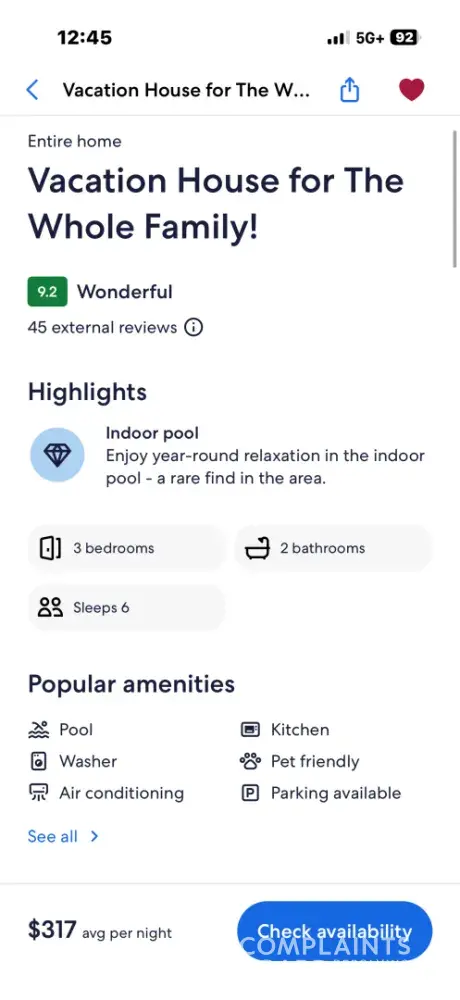
For $5,541.06, this property advertised an indoor pool.
There was no indoor pool.
Not closed. Not broken. Not unavailable.
Nonexistent.
The washer and dryer were also completely inoperable. I rejected the property and left within roughly 12 hours.
One might imagine the matter would then require approximately twelve seconds of corporate reasoning: We advertised something that does not exist; return the money.
How quaint.
Instead, Vrbo converted an obvious refund into a months-long bureaucratic hostage negotiation—disputes, documentation, complaints, government intervention, and preparation for arbitration—all over money they ultimately returned anyway.
The pièce de résistance came when Vrbo told the New York State Attorney General that I had not provided proof of the property’s misrepresentation and was unable to do so.
An exquisite claim, considering the evidence had been provided—and included Vrbo’s own written admission that the property had no indoor pool.
In ordinary English, we have a wonderfully efficient word for that:
A lie.
Apparently the business theory was ingenious: advertise the imaginary amenity, collect the very real money, deny the very real evidence, and make the customer crawl through enough procedural sewage that perhaps he will eventually surrender.
I did not.
After months of this spectacle, every cent of my $5,541.06 was reimbursed.
The great irony is that the missing indoor pool became almost secondary. Buildings can have defects. Appliances can fail.
But truthfulness is not an amenity.
And integrity should not require arbitration.
Recommendation: AirBnB or a tent!


 Exoticca Travel
7 reviews
Exoticca Travel
7 reviews
 Vacation Rent Payment
6 reviews
Vacation Rent Payment
6 reviews
 30A-Vacay
3 reviews
30A-Vacay
3 reviews
 Gogo Charters
1 review
Gogo Charters
1 review
 Booked Travel Concepts
1 review
Booked Travel Concepts
1 review


