Menu

Login

 Replied
Please provide as much information as possible:
Open Minds Therapy LLC held a Virtual Office agreement (PRT11399484) at Regus Columbia Main Street, 1501 Main St, Suite 501, Columbia, SC 29201, at $98.25/month from February 2024. On 11/9/2025, Regus sent an email self-described as a "Virtual Office Renewal - Courtesy Reminder" with a 21-day opt-out deadline of 11/30/2025 for a renewal beginning 3/1/2026 through 8/31/2026 at $134.20/month, a 36.6% increase disclosed only within that courtesy email. No separate notice, no mechanism for affirmative consent. The center was also unstaffed during contracted hours on 12/11/25, 12/22/25, 12/26/25, 12/31/25, 2/2/26, 2/26/26, 3/2/26, and 3/18/26. A witness observed the Community Associate sleeping behind the desk during business hours. I raised detailed legal arguments citing the FTC Negative Option Rule and the SC Unfair Trade Practices Act in writing on 3/24/2026. The center responded with a form letter that did not address a single substantive point. Every corporate email I have attempted, including [protected]@regus.com and lorraine.[protected]@regus.com, has bounced. Regus does not appear to maintain a functioning corporate escalation pathway for consumer disputes. Complaints filed with BBB and SC Dept of Consumer Affairs.
Country: United States
Address: 1501 Main Street, Suite 501, Columbia, SC 29201
Claimed loss: 134.20
Desired outcome: Immediate cancellation of agreement, full refund of all charges applied to the 3/1/2026-8/31/2026 renewal term, confirmation no further charges will be applied, and return of refundable retainer.
Confidential Information Hidden: This section contains confidential information visible to verified Regus representatives only. If you are affiliated with Regus, please claim your business to access these details.
Jennifer and Regus Account Helpdesk,
I am writing one final time before proceeding with formal regulatory filings. I want Regus to have a complete and documented understanding of the record I am bringing to those agencies.
Regarding the November 9, 2025 Email
The November 9 email was sent at 8:25 PM on a Sunday evening. It was not sent during normal business hours. It was not sent on a business day. A time-sensitive contractual notice with a 21-day opt-out deadline, sent outside of business hours on a weekend, does not meet any reasonable standard of clear and conspicuous disclosure. The off-hours delivery reduces the probability of engagement without technically failing to deliver. That distinction is precisely what the FTC's Negative Option Rule is designed to address.
The subject line of that email reads 'Virtual Office Renewal - Courtesy Reminder.' Regus's own framing characterizes this communication as a courtesy. A communication framed as a courtesy cannot simultaneously function as the sole formal contractual notice binding a subscriber to a six-month term and a 36.6% rate increase. Those two functions are incompatible, and the framing actively works against the level of consumer attention the deadline requires.
The opt-out deadline of November 30, 2025 gave me 21 days to prevent a renewal that would not begin until March 1, 2026. That is a four-month gap between the opt-out deadline and the start of the renewed term. No reasonable small business owner is reviewing virtual office contract renewals in November for a March term. The notice window is not designed to inform. It is designed to expire unnoticed.
Regarding the December 2, 2025 Email
The December 2 confirmation email arrived after the opt-out window had already closed. It confirmed the renewal had executed at $134.20 per month and offered a 10-day window to contact Regus with questions. It did not offer any cancellation option. It did not offer any opt-out mechanism. It was a notification that an irreversible financial commitment had already been made on my behalf through inaction, with no remaining recourse within the Regus system.
Regarding the Pattern of Practice
This is not an isolated administrative error. It is a documented, sustained, and willful pattern of consumer harm spanning more than a decade.
In January 2015, a class action lawsuit was filed against Regus PLC and HQ specifically alleging failure to provide proper notice before automatic contract renewals. The service named in that litigation was Mailbox Plus. That is the exact service at issue in my agreement. The harm described in that litigation, fees charged to consumers who were unable to cancel due to inadequate notice, is the exact harm I am documenting here.
On October 5, 2020, the Better Business Bureau contacted Regus directly regarding a documented pattern of consumer complaints involving undisclosed recurring charges and negative option enrollment without affirmative consent. The BBB specifically cited the requirement that advertisers must not interpret a consumer's silence, failure to take an affirmative action, or failure to cancel as consent to enroll in a negative option feature. As of October 21, 2020, Regus failed to respond to the BBB's requests.
That means Regus has been on documented notice of this exact practice since at least 2015. Class action litigation did not produce a change in practice. A formal BBB pattern of complaint notification in 2020 did not produce a change in practice. My situation in 2025 and 2026 is the same pattern, applied to the same service, producing the same harm.
The complete sequence in my case is as follows: a courtesy reminder sent at 8:25 PM on a Sunday with a 21-day opt-out window for a renewal four months away, containing a 36.6% rate increase embedded in the body of the email, followed by a post-renewal confirmation with no exit mechanism, followed by a pattern of correspondence in which every substantive legal argument I raised was met with a restatement of Regus's contractual position rather than engagement with the argument itself.
This structure is directly implicated by the FTC's updated Negative Option Rule, 16 C.F.R. Part 425, which requires that negative option features be clearly and conspicuously disclosed and that cancellation mechanisms be easy to use. It is also implicated by the South Carolina Unfair Trade Practices Act, S.C. Code Ann. Section 39-5-10 et seq., which prohibits unfair or deceptive acts in trade or commerce and provides for treble damages and attorney's fees where willful conduct is established.
Willfulness is not difficult to establish here. Regus has been on actual notice of this practice through class action litigation since 2015 and through a formal BBB pattern complaint since 2020. Continuation of the same practice through 2025 and 2026 is not an oversight. It is a business decision.
The class action documentation, the BBB alert record, and the complete correspondence record in this matter will be included in every regulatory filing as evidence of that willfulness.
I will not be making further payments toward this renewal term. I consider the renewal procedurally defective and the agreement void. I have already paid two months toward this disputed term. Those amounts are included in the damages I intend to recover.
Formal complaints are being filed with the Federal Trade Commission, the South Carolina Department of Consumer Affairs, and the Better Business Bureau. This is the final communication I will be directing to the center level. Further correspondence should be directed to kdaniels@openmindstherapy.org.
Kevin Daniels, Owner

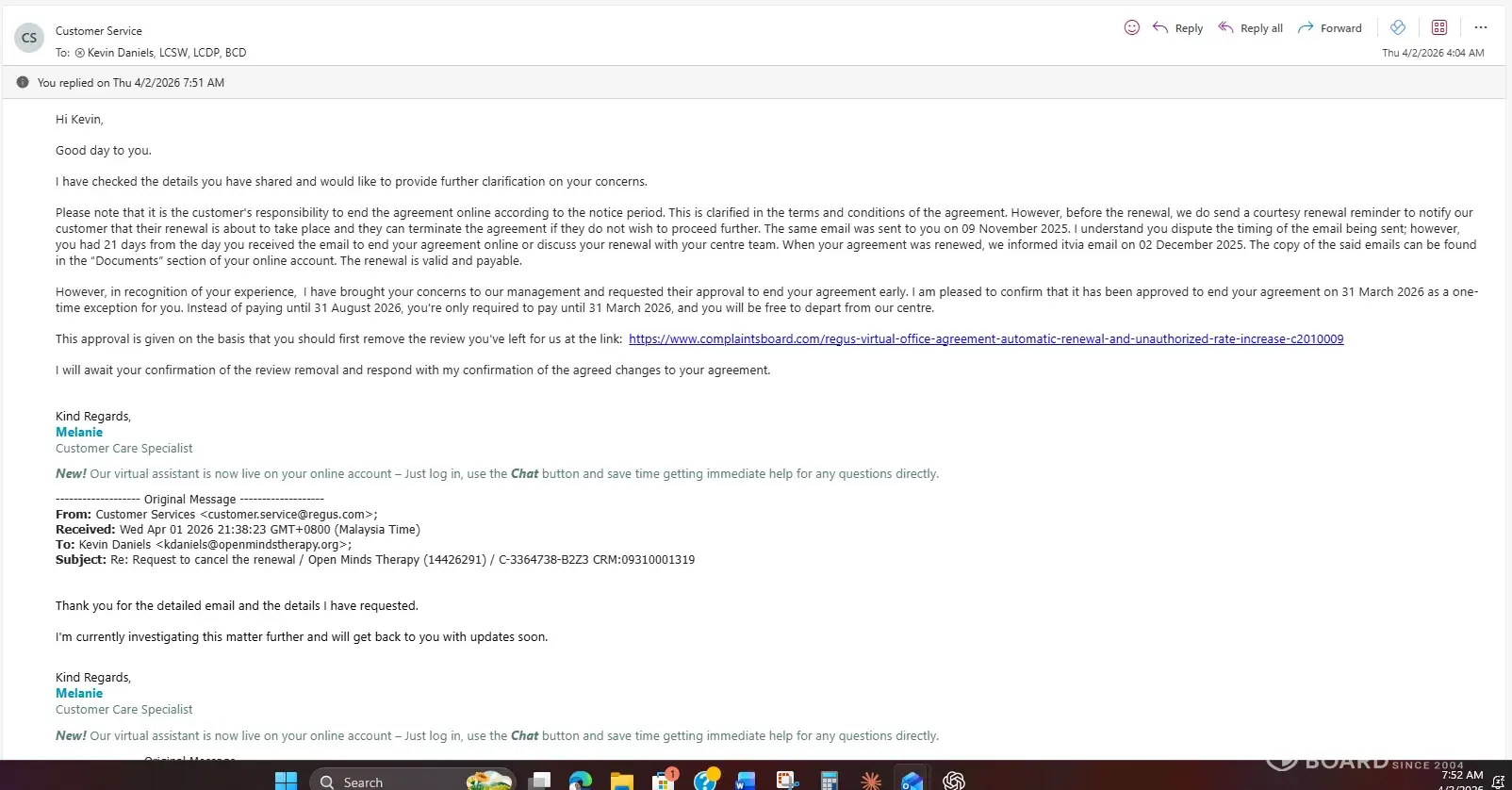
I'll let this speak for itself. Y'all can stop emailing and calling. I'm done with the back and forth.
Lorraine,
You can call my account inaccurate. You cannot make it so.
My review describes my experience with Regus. The fact that numerous other customers have posted nearly identical accounts is not coincidence, and it is not something a corporate reply resolves by asserting the matter is closed.
More directly: your associate offered to refund me if I removed my review. I have that exchange in writing. That offer is not consistent with a company whose position is that the customer's comments are inaccurate. Companies do not pay to remove accurate rebuttals of false claims. They pay to remove accurate accounts they would rather not have public.
I am not asking you to agree with my review. I am telling you that characterizing my experience as inaccurate, while your own team has offered money contingent on its removal, is not a position Regus wants on record.
I am willing to share the full email exchange, including the refund-for-removal offer, with whoever at Regus is actually responsible for reviewing this kind of conduct. If that is you, let me know. If it is not, please direct me to the appropriate person.
The review stays up.
Kevin Daniels
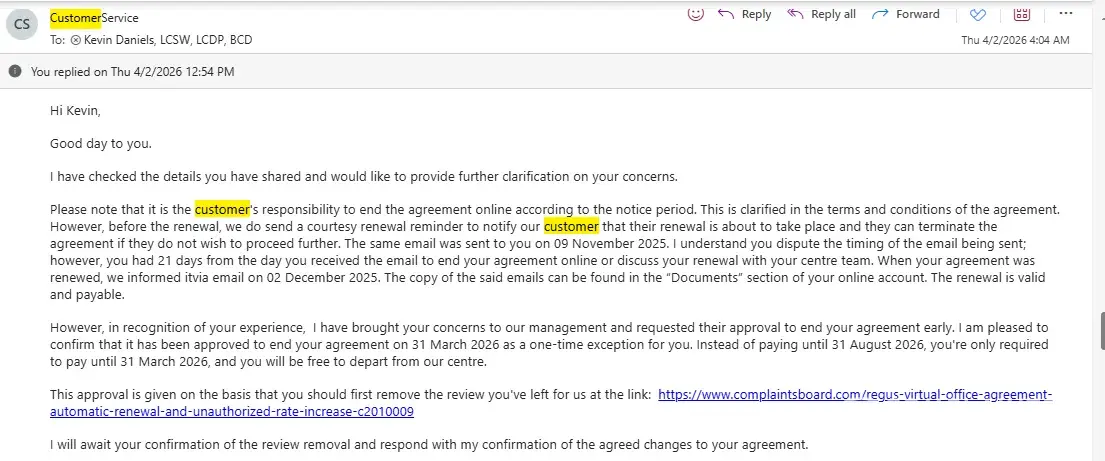
Got a collection letter from regus today: my response via secure message: I am writing regarding the collections demand referencing account [protected], claimed balance $160.84. I have several specific questions that require written answers before any payment discussion can proceed.
First, I am requesting a complete itemized breakdown of every charge currently comprising this balance, including the date each charge was assessed, the specific invoice number it appears on, and the stated basis for the charge.
Second, I need an explanation for why late payment fees appear on this account at all. I was told, through written correspondence with your colleague Melanie on April 2, 2026, that my agreement would be ended early effective March 31, 2026. That offer was conveyed in writing. Late fees presuppose an undisputed, valid obligation. This balance has been under active formal dispute since March 2026, with complaints filed with the FTC, CFPB, SC Department of Consumer Affairs, and the BBB. Assessing late fees on a formally disputed balance requires explanation.
Third, I need to understand whether the late fees are connected to my decision not to remove my consumer review on Complaintsboard. On April 2, 2026, your colleague Melanie offered me an early termination effective March 31, 2026, contingent on removing that review. I declined. On April 15, 2026, Lorraine Brule responded publicly to my review and characterized my account as inaccurate. Two rounds of late fees followed in April and May 2026. The chronology raises a question I am putting in writing: are these fees being assessed as a consequence of my refusal to remove a factually accurate consumer complaint?
Fourth, the account on this demand is listed as 'N/A.' My business is Open Minds Therapy, LLC. That name appeared correctly on invoices through April 1, 2026 and was removed on April 13, 2026 without my authorization or notice. I will not pay an invoice issued to a nonexistent entity. I am requesting immediate correction of the account name and reissuance of all invoices under the correct business name before any payment discussion proceeds.
I will be updating my Complaintsboard review with this correspondence and all related documentation, including the collections demand, the conditional review-removal offer, and this message. That is my right as a consumer.
This message, along with the full correspondence record, will be submitted as supplemental documentation to all open regulatory filings.
Kevin Daniels
Account [protected]


 Net32
14 reviews
Net32
14 reviews
 Opus Virtual Offices
11 reviews
Opus Virtual Offices
11 reviews
 Terra Management Services
6 reviews
Terra Management Services
6 reviews
 OfficeCrave
1 review
OfficeCrave
1 review
 Steelcase
13 reviews
Steelcase
13 reviews


