Menu

Login

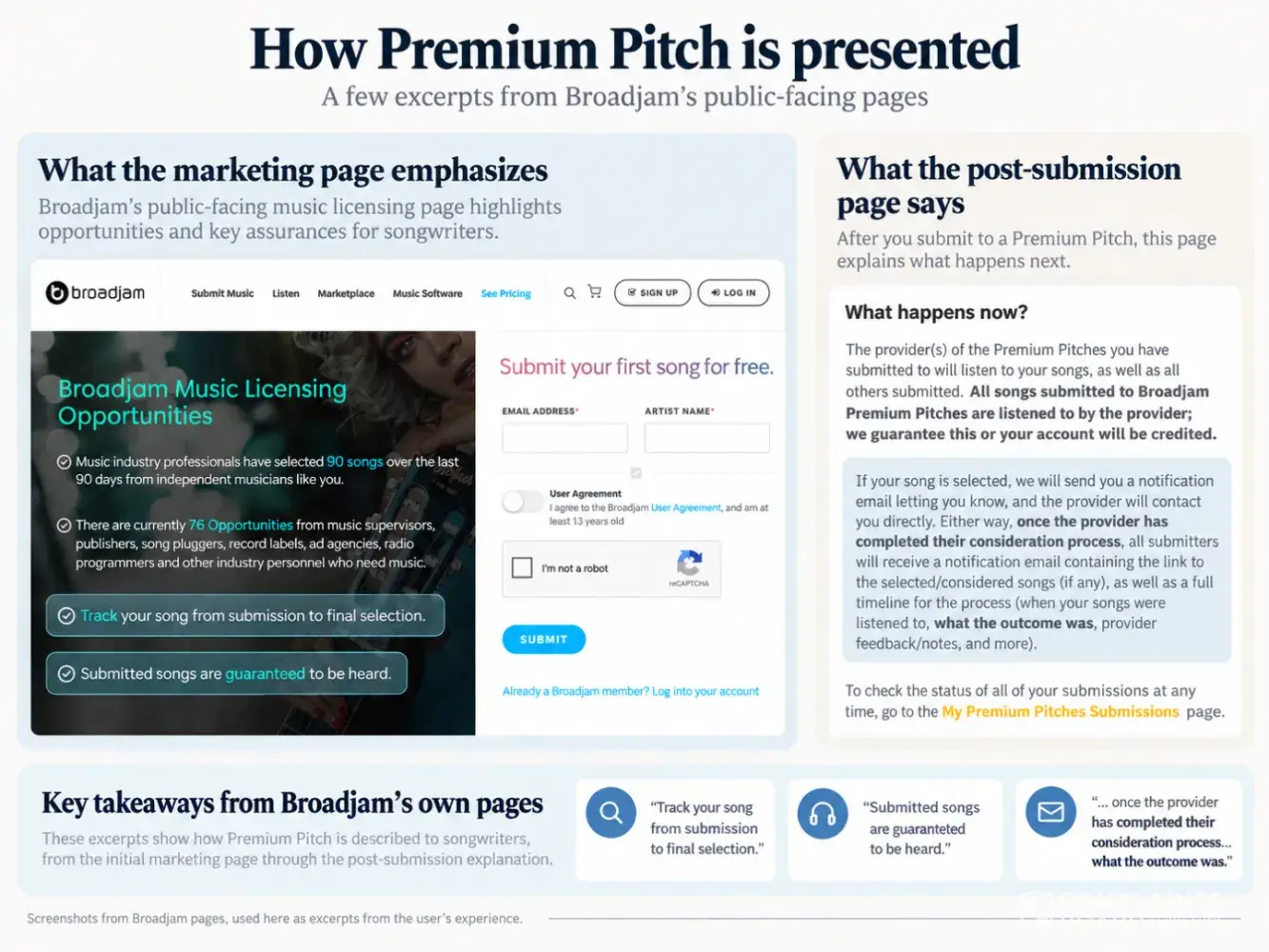
I joined Broadjam in 2016. Broadjam says I renewed for eight consecutive years, bought more than 15 submission packages, made more than 850 standard licensing submissions, and submitted 48 songs to 33 Premium Pitch opportunities. Over that time, I spent thousands of dollars. I played the long game.
This is not a one-star review because my songs were rejected. Music licensing is competitive and subjective. My issue is more basic: Broadjam sells musicians repeated access to paid licensing opportunities without providing the outcome data needed to judge whether that paid service actually produces placements.
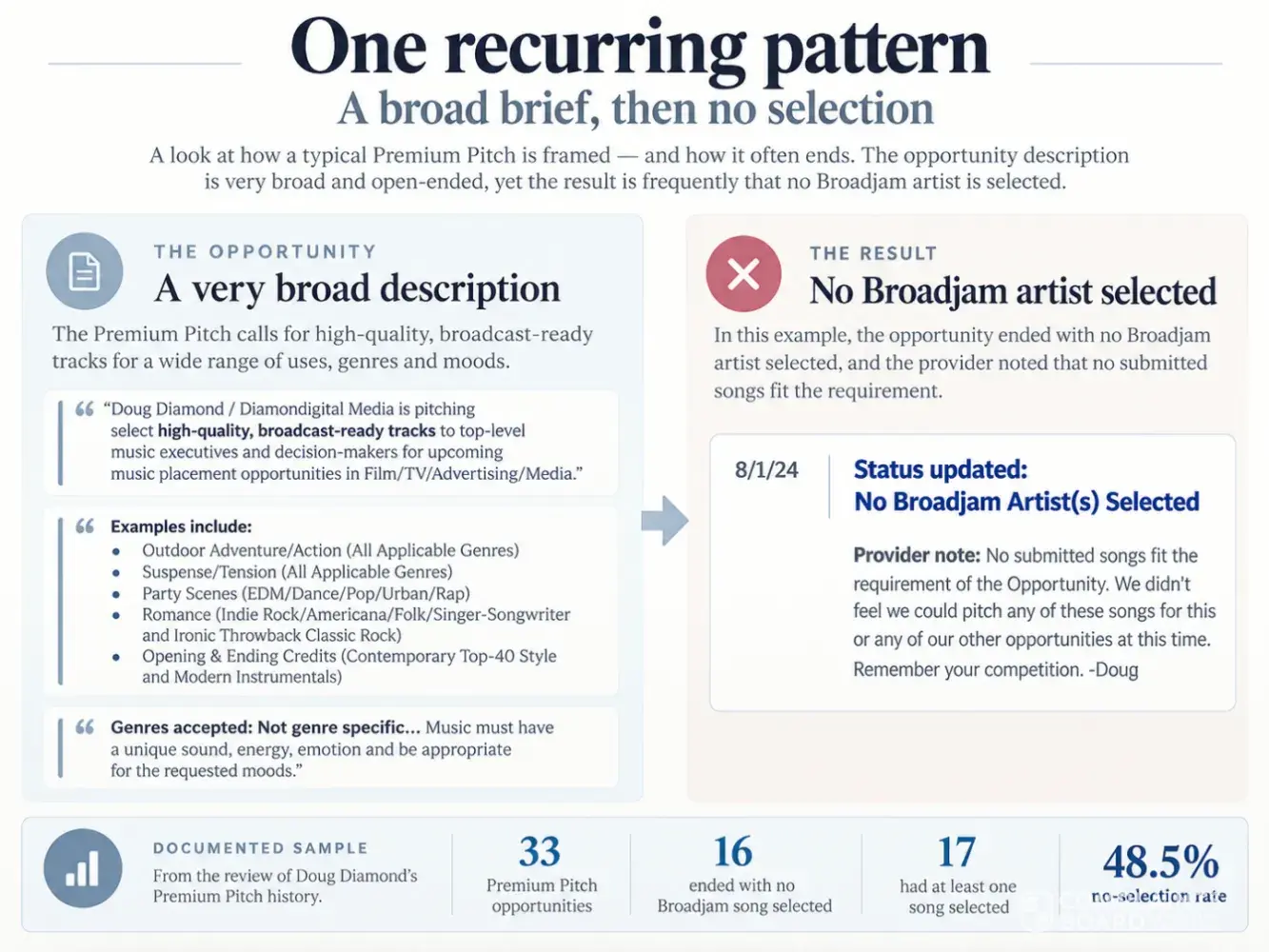
Of the 33 Premium Pitches I documented, 16 ended with no Broadjam song selected; 17 had at least one selection — a 48.5% no-selection rate. Some briefs were extraordinarily broad — “all styles,” “not genre specific,” multiple moods and uses — yet closed with “No submitted songs fit the requirement” and, in one case, “Remember your competition.”
A submission is not a selection. A selection is not a placement.
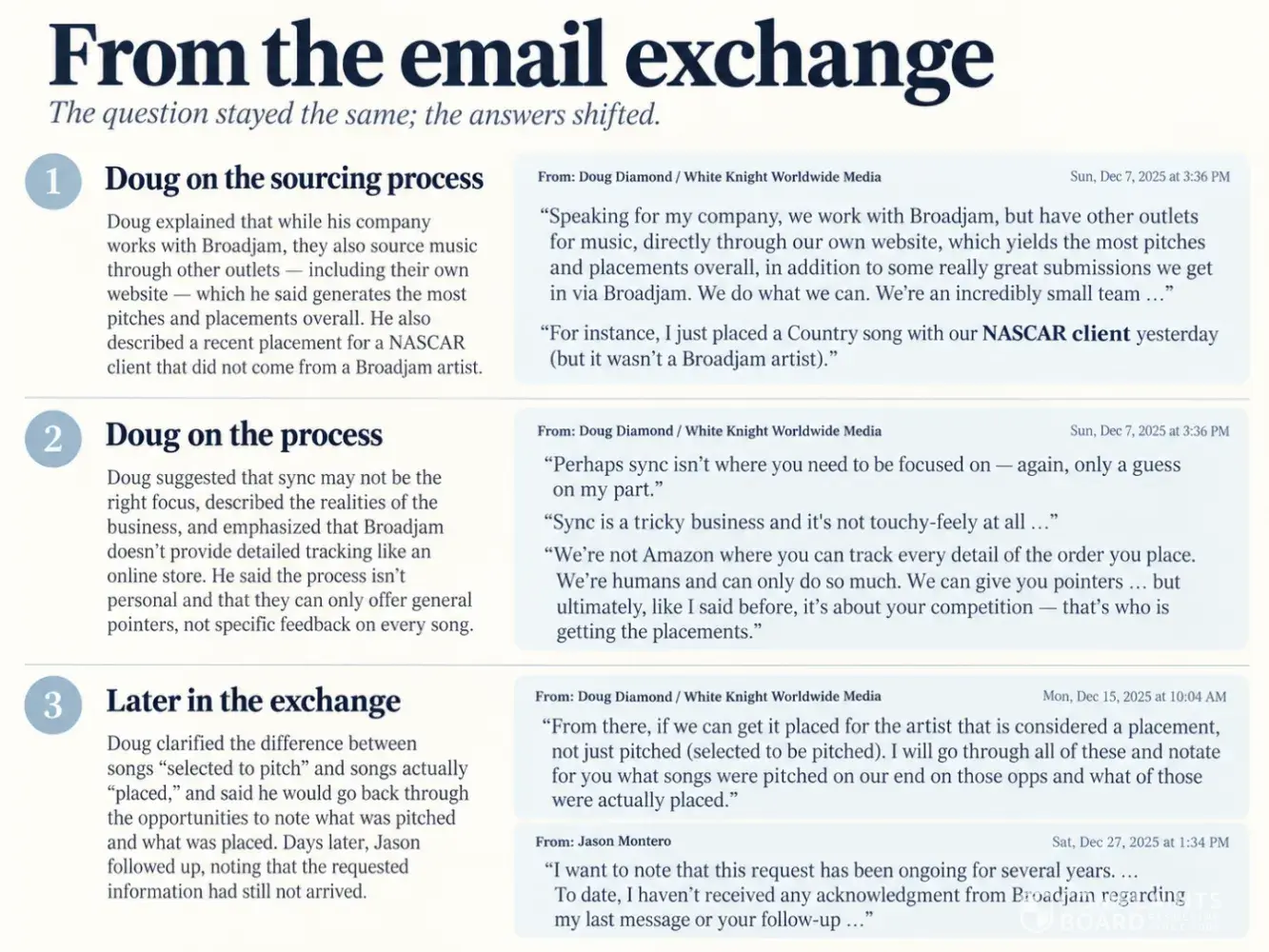
Doug Diamond, one of the Premium Pitch providers I dealt with most, explained the structure in writing. His company also sources music outside Broadjam through its own website, which he said yields “the most pitches and placements overall.” In the same email, he cited a NASCAR placement and noted that it “wasn’t a Broadjam artist.”
There is nothing inherently wrong with sourcing music from multiple places. But if Broadjam artists pay extra to enter one pool while the provider also draws from another, what does the extra “Premium” fee buy beyond paid consideration, and how often does the Broadjam pool produce the placement? I asked that for years.
The replies shifted to my music, whether sync was right for me, and how competitive the business is. Eventually Doug distinguished songs “selected to pitch” from songs actually “placed” and said he would tell me what had been pitched and what had actually been placed. That accounting never arrived.
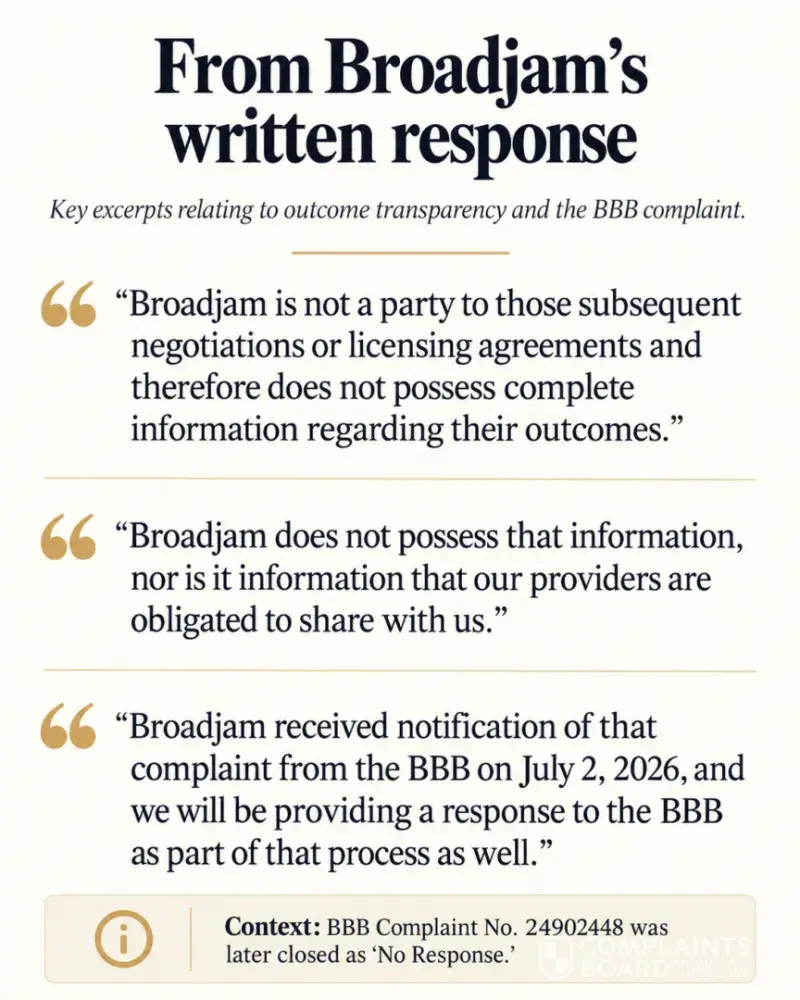
Broadjam’s Wisconsin consumer-protection response made the gap clearer: Broadjam said it does not possess complete information about downstream licensing outcomes and does not know how frequently third-party providers use Broadjam compared with outside sources. That matters because the money is collected at submission, whether or not anything is selected, pitched, or placed.
The scale is not trivial. On March 11, 2026, I observed 12 active Premium Pitches. My documented opportunities averaged about 18 submissions. Using Broadjam’s asserted $15 member price, if that activity were representative over eight years, that projects to roughly 20,700 paid submissions and about $311,000 in Premium Pitch submission fees alone. That is an extrapolation, not Broadjam’s accounting.
Premium Pitch functions less like a transparent pathway to sync licensing and more like a pay-to-submit vanity marketplace built around access, consideration, and selection. At the same time, the actual commercial result remains opaque. That conclusion came after eight years, hundreds of submissions, thousands of dollars, and years of asking the same basic question.
An earlier warning sign involved Pro Reviewer Stuart Epps, who cold-contacted me about paid production work; a later exchange with another Broadjam user raised questions about how my music was being represented.
I tried to resolve this privately. BBB Complaint No. [protected] was closed as “No Response.” Broadjam later told Wisconsin consumer protection it would respond to the BBB.
If you are an independent artist considering Broadjam primarily for licensing, ask one question before spending the money: How many paid Premium Pitch opportunities actually result in a Broadjam artist receiving the licensing placement? After eight years, I still could not get that answer.
Recommendation: I would put the money elsewhere.


 AllMusic
3 reviews
AllMusic
3 reviews
 Eleventyfour
1 review
Eleventyfour
1 review
 Taylor Swift
10 reviews
Taylor Swift
10 reviews
 Starlight PR
3 reviews
Starlight PR
3 reviews
 Afton
3 reviews
Afton
3 reviews

